
The Anti-Algorithm: Why the Next Great Social Network Looks More Like a Physical Bookshelf

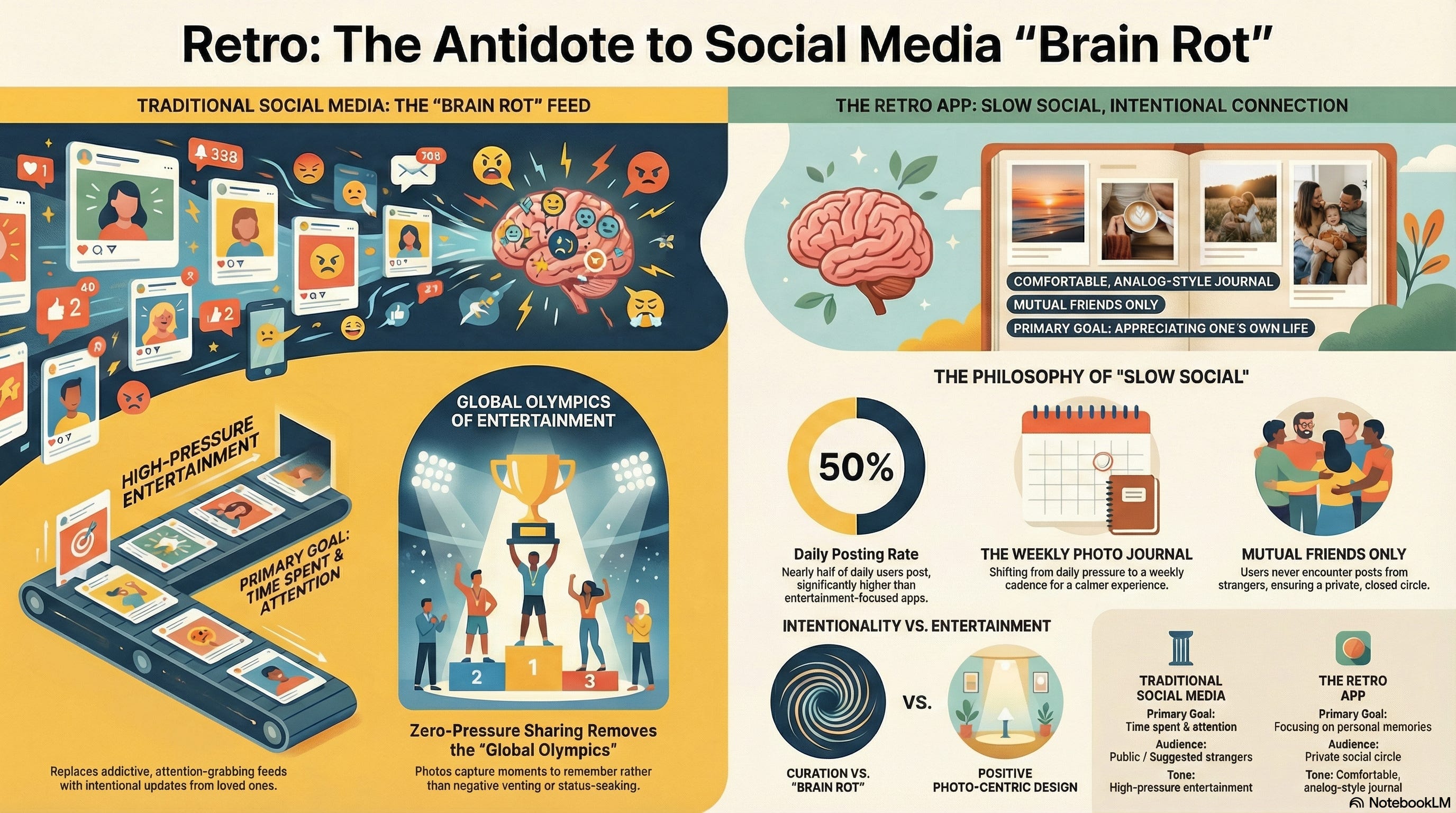
Modern social media has devolved into what can only be described as a state of “incentive-driven product decay.” We open an app to catch up with a friend, only to be swallowed by a 40-minute vortex of algorithmic “reels”—a phenomenon users now aptly call “brain rot.” This is not an accident; it is the inevitable result of a corporate model that prioritizes the “time spent” metric over human flourishing.
When Nathan Sharp and Ryan Olson—the product and iOS leads behind Instagram Stories—left Meta, they weren’t just looking for a new project; they were escaping the “Global Olympics of the best entertainers.” They remembered a “magical month” at Instagram, just before Stories launched to the public, when the feature was only used by the internal team. For the first time, Sharp saw a window into his colleagues’ real lives: he discovered a co-worker was a rock climber and another lived just down the street. It was a private, high-trust environment that vanished the moment the product was commodified for the masses.
Retro, their new venture, is a deliberate attempt to reclaim that magic. It is a weekly photo journal designed to be the antidote to the broadcast era.
The Reciprocal Graph: A Tactical Moat for Intimacy
Retro takes what Sharp calls the “hard path” by fundamentally rejecting the creator-audience divide. In the current social landscape, intimacy has been sacrificed for reach. Traditional platforms encourage “lurker culture,” where a few high-output entertainers provide content for millions of passive consumers.
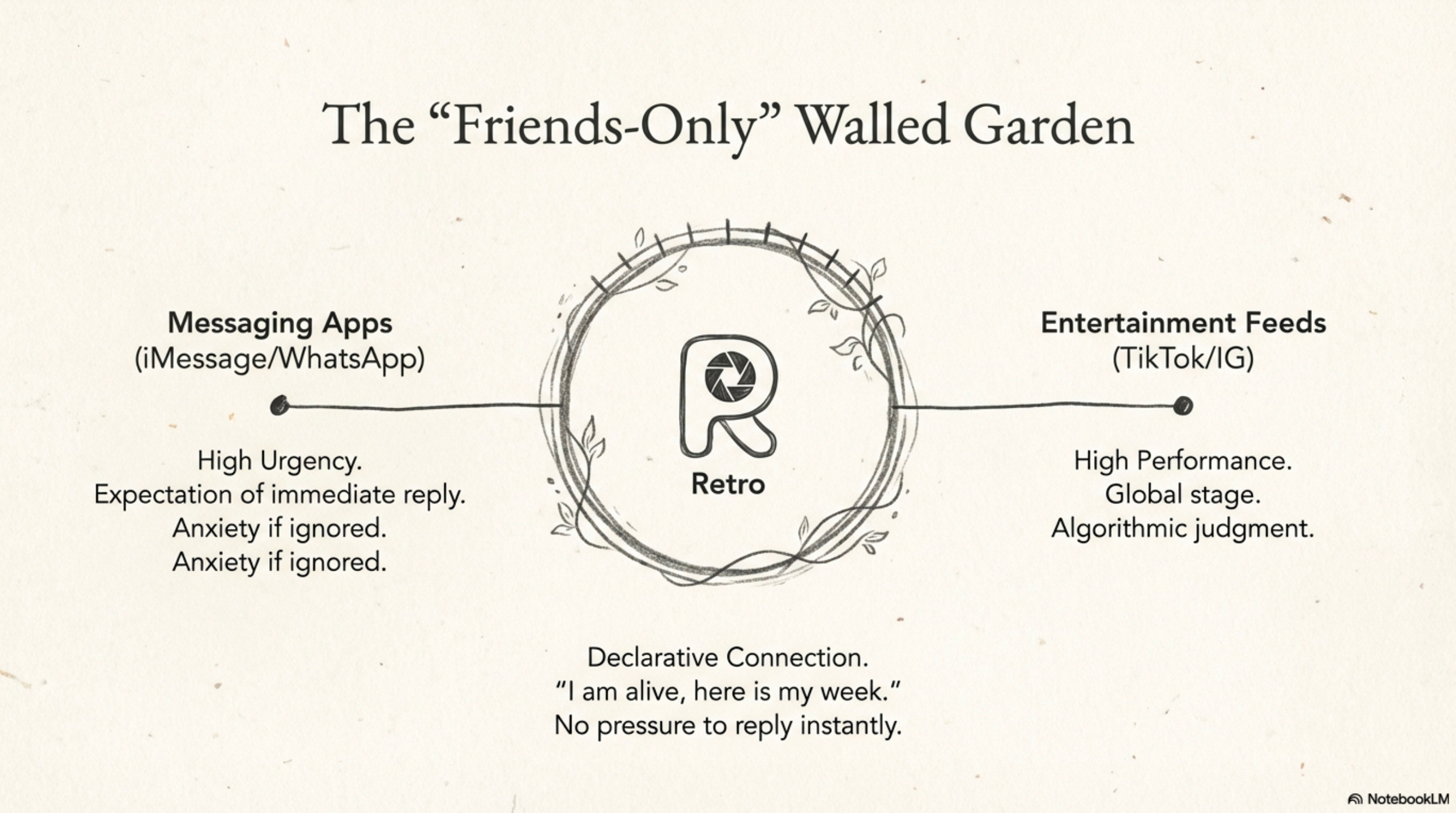
Retro breaks this by implementing a reciprocal graph. This is not merely “friends-only” privacy; it is a structural firewall. To see someone’s life, they must be able to see yours. This model serves as a strategic moat against the performative pressure of the “Global Olympics.” As Sharp notes:
“By posting on other apps that have gone really hard on entertainment, you’re kind of saying, ‘this post is also entertaining and I think it’s worth your time.’ You hold yourself to that bar, which most people and most photos don’t meet.”
By killing the lurker/creator hierarchy, Retro transforms the “boring” cup of coffee or the blurry photo of a child’s drawing from a failed piece of content into a valuable personal memory.
The 50% Participation Paradox: The Power of Low Cadence
In the industry, the “90-9-1” rule is gospel: 90% of users lurk, 9% contribute occasionally, and 1% create the vast majority of content. Retro has shattered this with an “outrageous” statistic: nearly 50% of its daily active users also post content.
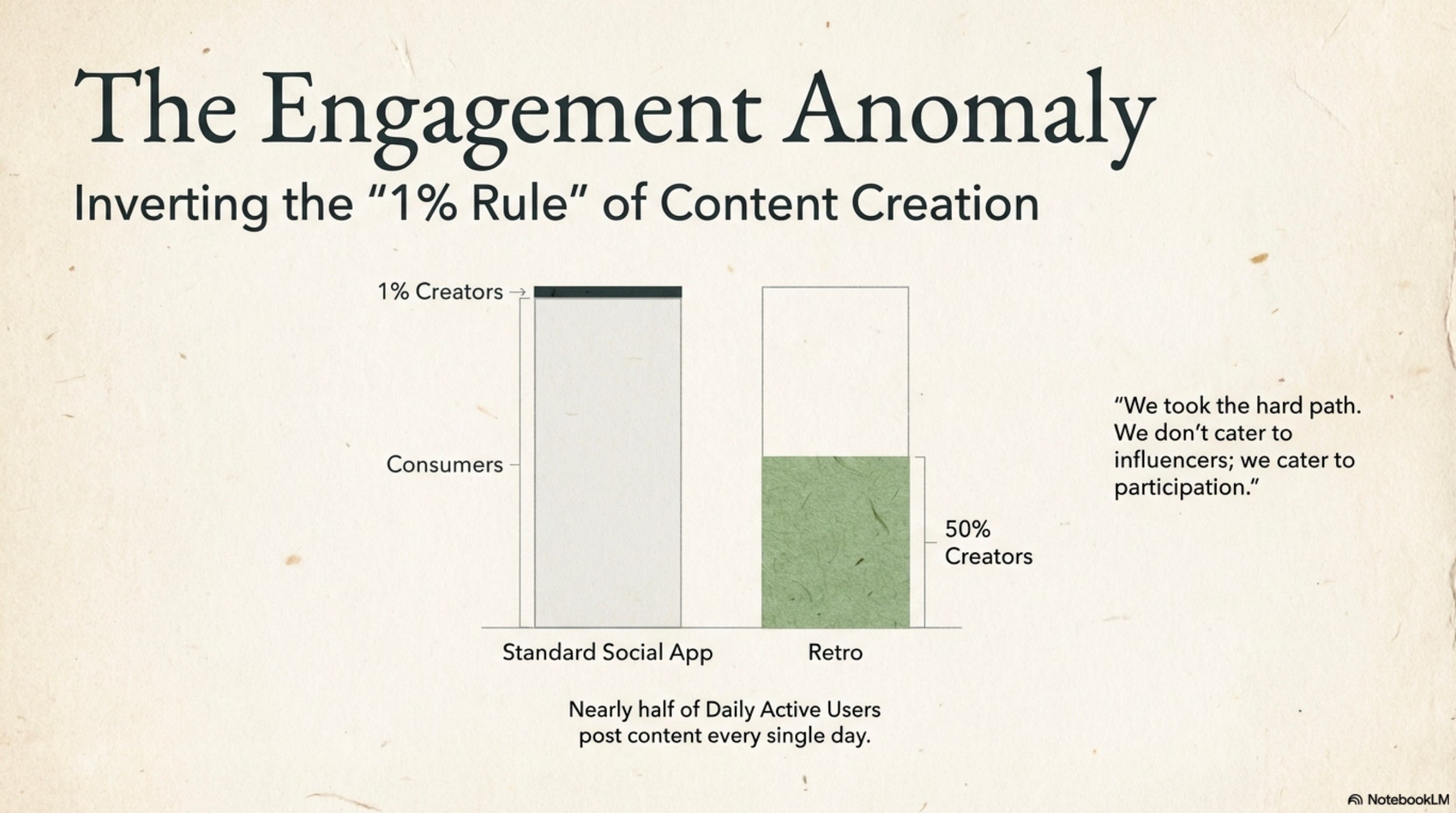
This high participation is the result of “depressurizing” the social experience. The strategic lever here is the weekly cadence. Sharp argues that while most people don’t encounter something extraordinary every day, they almost always do once a week. By shifting the focus to a “weekly journal,” Retro removes the daily requirement for “interestingness.”
This shift creates a distinct “Calm Tech” differentiator compared to the high-stakes environment of messaging:
The Group Chat Anxiety: In a WhatsApp or iMessage group, silence is a social slight. If you post a photo and nobody responds within 24 hours, the silence feels heavy.
The Retro Calm: In Retro, if a post isn’t seen immediately, it’s irrelevant. The app is built for intentional check-ins. Silence simply means “they’ll see it when they check in next week.”
Digital Wabi-Sabi: The Patina of a Life Built Over Time
The philosophy of Retro is deeply informed by physical intentionality. Sharp views his personal library not as a decoration, but as a “tool set.” This reverence for the physical is baked into the company culture; when an employee hits their one-year anniversary, they aren’t given a digital badge—they are gifted a physical book.
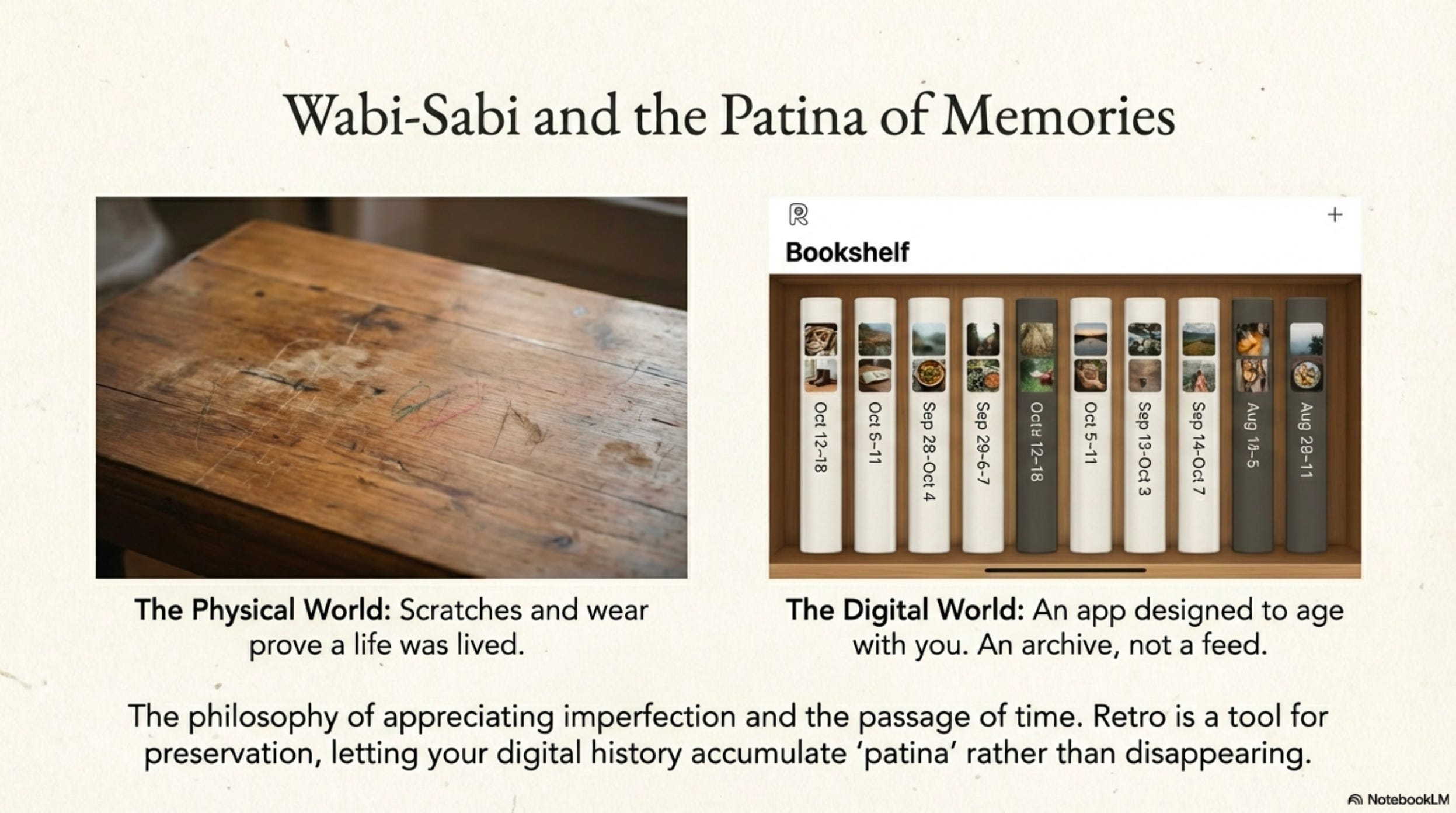
This translates to the app through the concept of Wabi-sabi—the Japanese aesthetic of finding beauty in imperfection and the passage of time. Sharp points to the “kid patina” on his wooden desk—the nicks and permanent marker stains—as marks that create meaning. This is the logic behind the “Albums” feature (originally titled “Journals”).
“Whenever something is physical in the real world... it’s intentional. And all of those things go on to remind you and kind of sear themselves in your mind.”
In Retro, “Albums” allow users to watch something grow—like a child’s art evolving from scribbles to sketches. It’s a digital version of that physical patina, capturing a “bird’s-eye view” of life that feels crafted and organized rather than ephemeral and chaotic.
The Trojan Horse: Viral Aesthetics in Asia
While headquartered in the US, Retro’s initial breakthrough occurred in Tokyo and Taipei. Through “detective work,” the team discovered that their growth in Taiwan was so explosive they eventually ranked #1 in the App Store, even above ChatGPT.
The growth wasn’t just cultural; it was tactical. Users were utilizing Retro to back-fill up to two years of memories, creating a “recap” loop. By selecting 3 to 30 photos and generating a collage or slideshow, users were sharing these “Recaps” back to the very platforms they were escaping—Instagram and Threads. This “Trojan Horse” strategy used the big platforms’ reach to siphon users into Retro’s private, reciprocal space. This back-filling of history was so intense that the team had to launch a subscription model early just to cover the high costs of hosting years of retroactive photo uploads.
Lone Palm: A Rejection of the “Super-App”
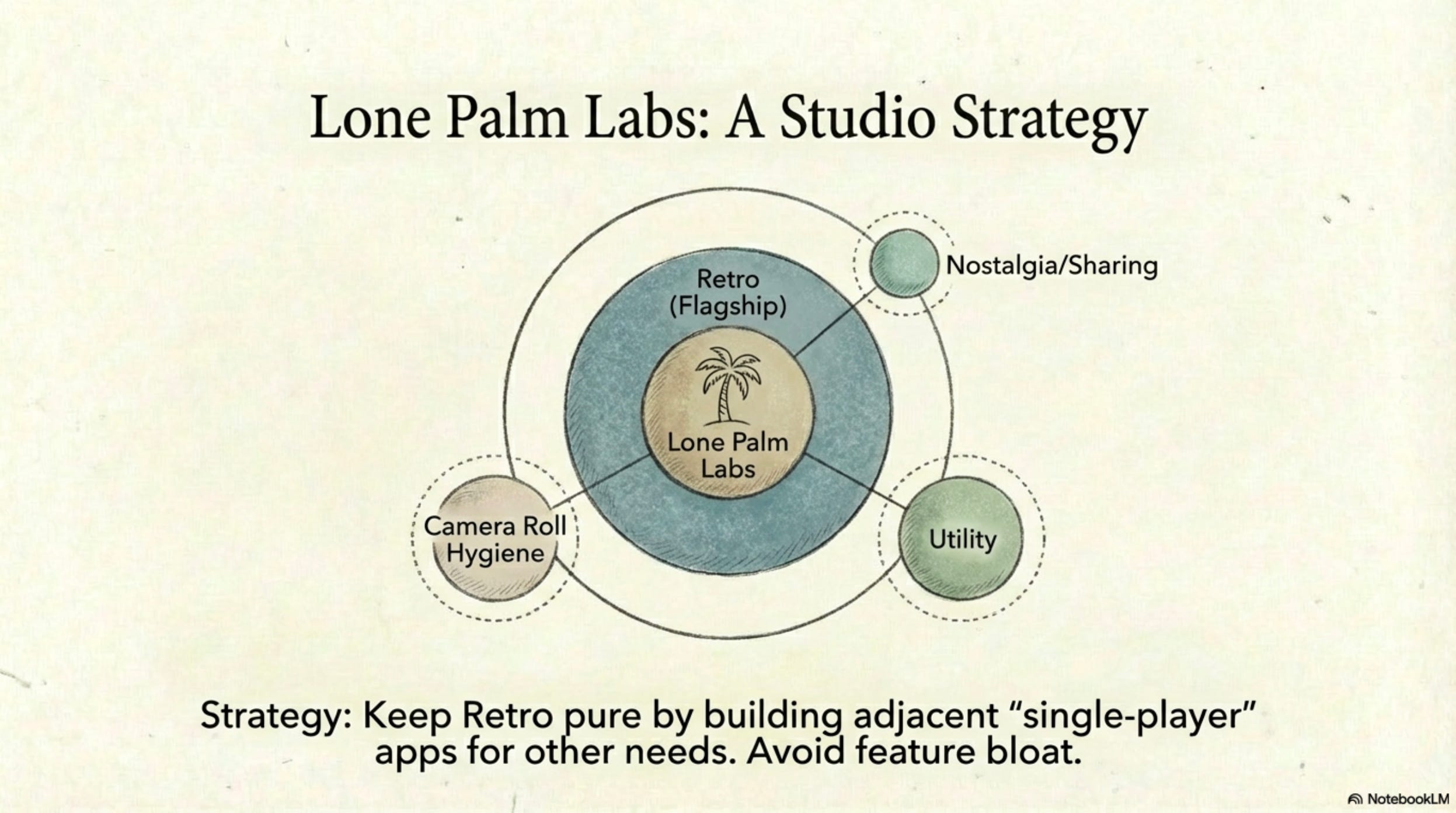
Retro is the flagship product of Lone Palm Labs, a consumer app studio that rejects the Meta-style urge to bloat a single product with every possible feature. Sharp’s strategy is built on the distinction between Single-Player and Multiplayer apps.
Rather than cluttering Retro with utilities, Lone Palm plans to launch standalone, “single-player” apps for tasks like clearing camera roll clutter or enhancing photos. This prevents the “incentive-driven decay” Sharp witnessed at Meta, where internal promotions are tied to moving a single metric, often leading to a complex, fragmented user experience.
The management philosophy is equally unconventional, inspired by Haruki Murakami’s The Wind-Up Bird Chronicle and his views on running as an endurance sport for the mind. Sharp focuses on “mapping enthusiasm to the project,” assigning tasks based on a team member’s current inspiration rather than rigid corporate goals. As Sharp puts it, you can’t force the work until “the water is flowing again.”
Conclusion: Toward a Private Future
The success of Retro suggests that we are entering a post-broadcast era of social media. The “Global Olympics” has left us exhausted, and the next great network may not be a network at all, but a collection of private, intentional spaces.
The future of digital connection lies in moving away from the “commodification of intimacy” and toward a model that values the “patina” of our actual lives. As we consider our own digital habits, the question is no longer which app can entertain us most, but which app helps us appreciate our own life. In a world of algorithmic noise, the most radical act is to build a bookshelf.